

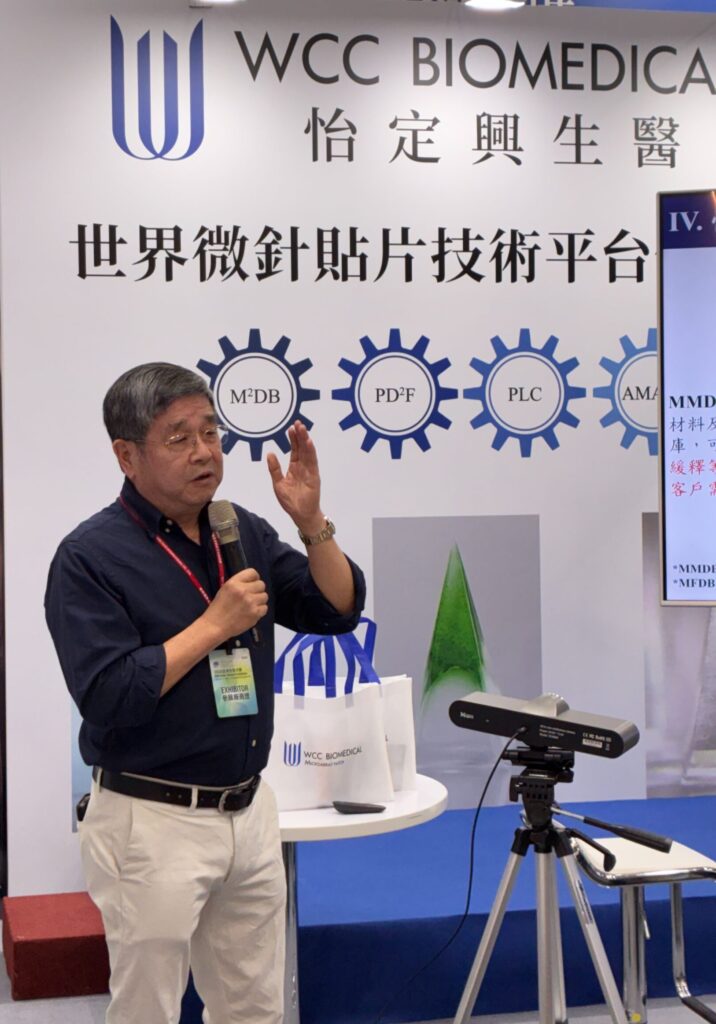
Microarray patches (MAPs) have promised painless, needle-free drug delivery for nearly three decades. The hard part was never the science — it was making the same patch ten thousand times without variation. At BIO Asia–Taiwan 2026, WCC Biomedical brought three product lines to show how its WINMAP™ platform is closing that gap [1].
Each sits at a different stage of maturity: WCC-301, an investigational analgesic patch in clinical development; WINMAP™ mini, a rapid sample-preparation system for R&D; and a consumer wellness range. As founder and chairman Dr. Ta-Jo Liu put it, the value of the platform is that a single microneedle technology can span applications from investigational drugs to everyday wellness, each with its own development standards [1].

Why microneedles matter
A MAP is a transdermal delivery system: an array of micron-scale needles that pass through the stratum corneum and release an active ingredient into the skin. Because the needles stay in the skin’s upper layers, they rarely reach the nerve endings that make injections hurt. And because they bypass the skin’s main barrier, they open a route for molecules — proteins, peptides, even mRNA — that ordinarily cannot be absorbed through the skin at all [2,3].
The interest is not merely academic. The World Economic Forum placed microneedle systems at the top of its 2020 list of emerging technologies with the potential to change society, and a VIPS assessment involving WHO, PATH, UNICEF, Gates and Gavi ranked the format first among vaccine delivery priorities [2,3].
The bottleneck nobody has solved
Despite that, no pharmaceutical or vaccine patch has yet reached FDA approval and commercialization. The obstacle is uniformity at scale. Needle geometry, drug loading, and the dose that actually enters the body all have to stay consistent — not just on a lab bench producing a few patches a day, but across a production run of 100,000 units [2,3].
WCC frames this as three linked problems: sufficient dose (delivering a therapeutically meaningful amount despite each patch’s small payload), precise dosing (controlling both what goes into the patch and what reaches the patient), and scalable manufacturing (running materials, microstructure fabrication, drug loading and quality control together under GMP conditions) [2,3].
WINMAP™ was built to answer all three. It combines in-house material and formulation databases, precision loading and coating for reproducible drug content, and a fully self-developed automated production system designed to international GMP standards — targeting under 3% batch-to-batch variation in drug loading, ten million patches per line, and yields above 95% [2,3].
The commercial logic behind it is deliberately staged: consumer products reach end users in the near term, R&D tools open up academic and industrial customers in the medium term, and high-value new drug development anchors the long term. WCC is also the first company in Taiwan to receive the Ministry of Economic Affairs’ “biotech and pharmaceutical company” designation on the strength of an innovative technology platform [1].
WINMAP™ mini: months to 30 minutes
Conventional dissolving microneedles bury the drug inside the needle body itself. That design has an awkward consequence — change the compound or adjust the loading, and formulation development effectively restarts, often costing months before a testable sample exists [1].
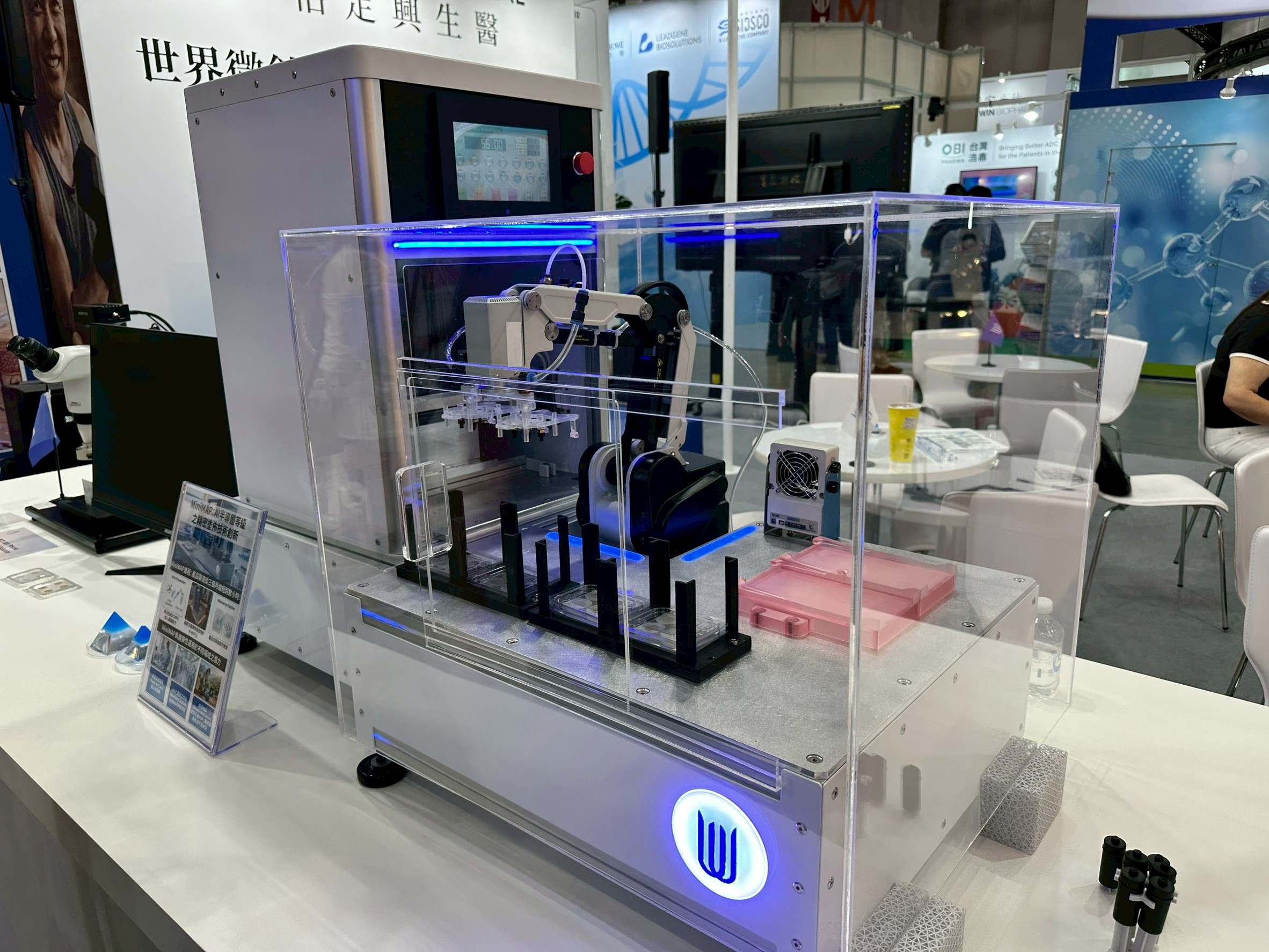
WINMAP™ mini attacks this by decoupling needle formation from drug loading. Built on hydrogel microneedles combined with polymer processing, the system keeps the needle body constant and changes only the coating solution when the drug changes. In its simplest configuration, a sample can be prepared in about 30 minutes [1].
Intended users are academic and research institutions, pharmaceutical formulation teams, and CDMOs running early-stage evaluations. Core patents were filed across major markets at the end of 2025, and the system received its first public live demonstration at BIO Asia–Taiwan 2026, with access currently prioritized for academic and research organizations [1].
WCC-301: clinical progress
WCC-301 targets local pain from acute sprain via the FDA’s 505(b)(2) pathway. Pain was a deliberate choice — common and recurring, it makes a clearer proof point for the platform than a rare indication would [2,3].
In single-dose minipig pharmacokinetics, all topical groups reached peak plasma concentration within 15 minutes, exposure rose proportionally with dose, and absolute bioavailability landed between 35% and 43% [2,3].
The programme has since completed GLP toxicology studies and production of clinical trial material. WCC has completed FDA Pre-IND consultation and plans a US IND filing in 2026, followed by a TFDA submission in Taiwan, using a combined Phase I/IIa design to compress the early clinical timeline. The platform is expected to extend to other localized pain indications over time [1,2,3].
Notably, key WCC-301 results have been independently reproduced by an external partner laboratory — an unusual external check in this field, and evidence that the platform behaves consistently outside WCC’s own facility [2,3].
Everyday wellness applications
The same platform reaches consumers through Power Patch and V Patch, both launched recently. Power Patch combines black maca root extract with L-arginine to support everyday vitality in men, using MAP delivery to bypass the absorption limits of oral supplements. V Patch addresses the “tech neck” concern common among heavy smartphone users, pairing hibiscus extract for antioxidant support with capsaicin to encourage local microcirculation. Both extend the platform’s precision delivery into daily self-care [1,2,3].
Taiwan's angle
“Taiwan cannot overtake the global pharmaceutical giants by walking the road they already walked,” says Dr. Liu [3].
His argument is that Taiwan’s real edge is not the scale of its drug discovery but the depth of its engineering — semiconductors, precision machining, automation, AI. Microneedles sit exactly at that intersection, demanding extreme manufacturing precision and serious scale-up capability. Several Taiwanese semiconductor and optoelectronics firms have already approached WCC about collaboration [2,3].
That is why the company is starting with a new formulation of an established analgesic: establish commercial-scale manufacturing first, then expand into higher-value applications.
Read the full interview
Dr. Liu’s complete conversation with GeneOnline goes considerably deeper — covering vaccine applications and the enterovirus 71 patch programme, the mRNA/LNP development pipeline, FDA uniformity requirements, and WCC’s international CDMO partnership discussions. We recommend reading it in full:
- English — GeneOnline, WCC BIOMEDICAL Overcomes Microneedle Array Patches Manufacturing Challenges, Advancing Next-Generation Drug Delivery → Read on GeneOnline
- 中文 — 基因線上,〈怡定興突破微針貼片量產瓶頸,為臺灣生技打國際盃〉 → 前往閱讀
WCC-301 is an investigational drug. It has not received marketing approval in any country, and its safety and efficacy have not been confirmed by any regulatory authority. Statements regarding regulatory timelines and clinical plans are forward-looking and subject to change.
Reference:
- 經濟日報 Economic Daily News. “30分鐘就能製作專屬微針? 怡定興生醫WINMAP™平台亮相生技展.” 17 July 2026. Press release via PR Newswire. Available at: money.udn.com. Also syndicated at Yahoo 奇摩股市, 16 July 2026: tw.stock.yahoo.com
- 基因線上 GeneOnline. 〈怡定興突破微針貼片量產瓶頸,為臺灣生技打國際盃〉. 18 July 2026.
- GeneOnline. “WCC BIOMEDICAL Overcomes Microneedle Array Patches Manufacturing Challenges, Advancing Next-Generation Drug Delivery.” 18 July 2026.